# The Cornetto ice cream cone framework for prompting
Prompting still matters, but I'm always skeptical of overly technical and sophisticated frameworks and guides.
So here's a sorta simple one, with two mnemonics to help you remember.
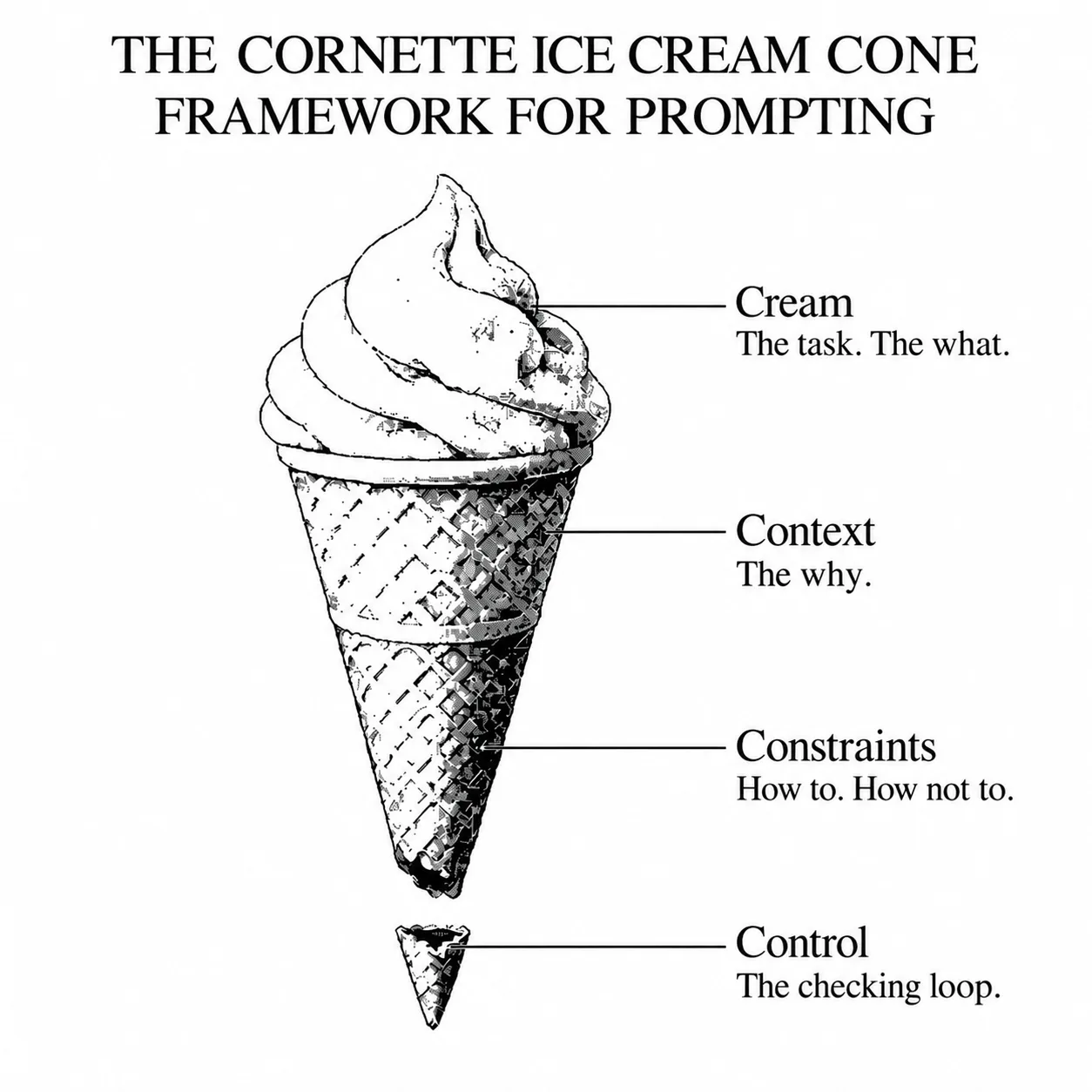 I think it's mostly obvious. The important part is that the control part of the prompt is a different system, meaning it doesn't know about the cream, context, and constraints; its only goal is to check the resulting output.
This helps with all sorts of hallucinations. I usually use subagents/different AIs with a fresh context window for this, but it can also be static tests in programming or, if you want, a human in the loop as well.
The name and image are inspired by the Cornetto ice cream, with the broken-off horn!
I think it's mostly obvious. The important part is that the control part of the prompt is a different system, meaning it doesn't know about the cream, context, and constraints; its only goal is to check the resulting output.
This helps with all sorts of hallucinations. I usually use subagents/different AIs with a fresh context window for this, but it can also be static tests in programming or, if you want, a human in the loop as well.
The name and image are inspired by the Cornetto ice cream, with the broken-off horn!
 Or you can also call it the **"three C"** or **"four C"** (depending on whether you count the cream or not) framework.
--------
If you think you will forget about this anyway, put something like this in the system prompt:
```
# ask for the three c's for medium to big tasks
Medium to big tasks are tasks that are not one off, aren't a simple question or something like filling out a form or parsing a pdf, it's building something new or synthesizing multiple things. Research doesn't fall under this.
### context
the why
### constraints
the how, and the how not
### control (aka, the loop)
the controlling, importantly, the control doesn't know about the context and constraints, usually subagents or more static control like red-green tests.
```
Or you can also call it the **"three C"** or **"four C"** (depending on whether you count the cream or not) framework.
--------
If you think you will forget about this anyway, put something like this in the system prompt:
```
# ask for the three c's for medium to big tasks
Medium to big tasks are tasks that are not one off, aren't a simple question or something like filling out a form or parsing a pdf, it's building something new or synthesizing multiple things. Research doesn't fall under this.
### context
the why
### constraints
the how, and the how not
### control (aka, the loop)
the controlling, importantly, the control doesn't know about the context and constraints, usually subagents or more static control like red-green tests.
```