The Retroactive Redemption Pattern
==================================
*They really thought they were cookin'*
Arguing against crackpots (and the fans they've gathered) is a losing battle.
Losing is [overdetermined](https://news.ycombinator.com/item?id=13164794), but I'd love to isolate one pattern here that people love to use: The Retroactive Redemption Pattern.
## I
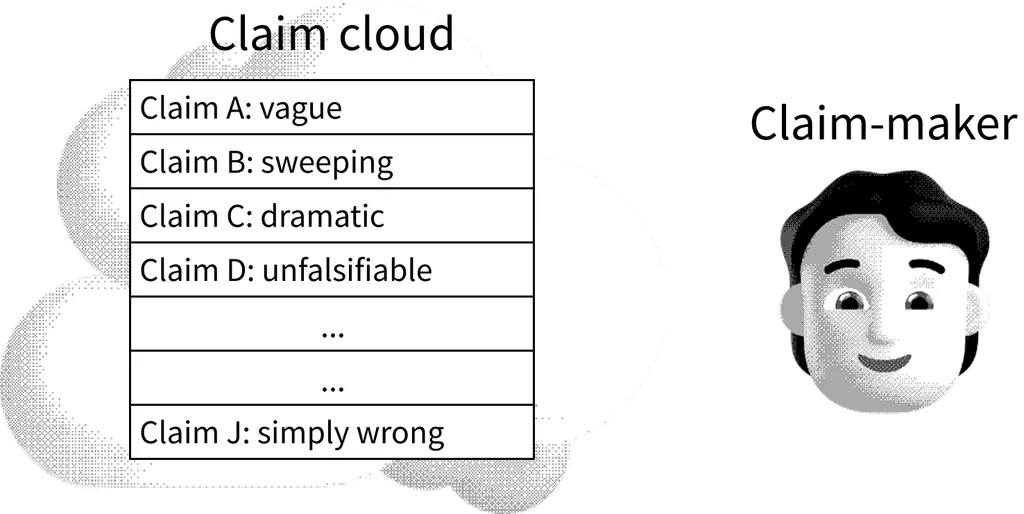
Any topic complex enough to be worth arguing about usually comes with a public person making a multitude of claims about it. We'll call that pile of claims the claim cloud:
 To be taken seriously, not every claim in the claim cloud has to be true. Being directionally right is important enough on its own.
But you see, the problem is this person is somewhat of a crackpot.
The person is a crackpot not because of the validity of their claims, but rather how the claims and the person's relationship to them interact with the wider world.
Let me introduce the element of time to illustrate this interaction:
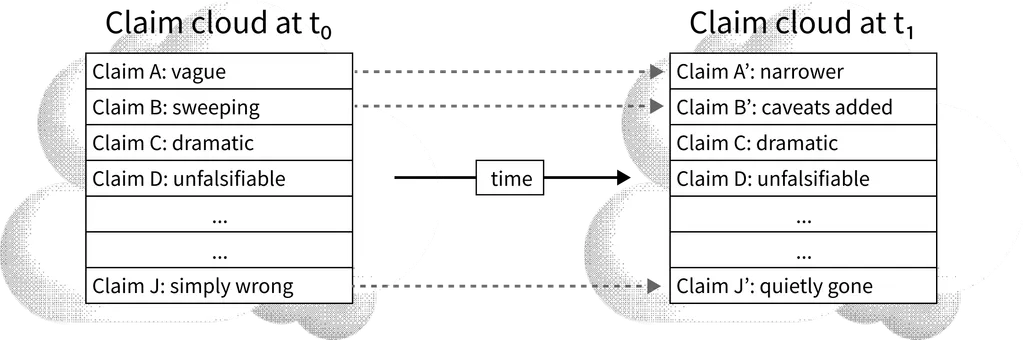
Over time, the original claims can become arguably more true, or arguably more wrong.
Claims rarely stay static, especially because there are subtle forces at play here: elasticity and ego.
The ego of the person is the central reason for the reshaping of the claims.
The crackpot subtly or not so subtly makes changes to the original claims: they become narrower, wider, or more convoluted, depending on how the events in the real world pan out.
Therefore, through the crackpot's ego, the claim cloud drifts from t0 to t1, toward whatever version looks most true in hindsight.
To be fair, one claim in the cloud may turn out simply true.
Yet, most of the cloud was still misleading in its original form.
The pattern kicks in when that one true fragment gets used as retroactive redemption for the whole cloud.
To be taken seriously, not every claim in the claim cloud has to be true. Being directionally right is important enough on its own.
But you see, the problem is this person is somewhat of a crackpot.
The person is a crackpot not because of the validity of their claims, but rather how the claims and the person's relationship to them interact with the wider world.
Let me introduce the element of time to illustrate this interaction:

Over time, the original claims can become arguably more true, or arguably more wrong.
Claims rarely stay static, especially because there are subtle forces at play here: elasticity and ego.
The ego of the person is the central reason for the reshaping of the claims.
The crackpot subtly or not so subtly makes changes to the original claims: they become narrower, wider, or more convoluted, depending on how the events in the real world pan out.
Therefore, through the crackpot's ego, the claim cloud drifts from t0 to t1, toward whatever version looks most true in hindsight.
To be fair, one claim in the cloud may turn out simply true.
Yet, most of the cloud was still misleading in its original form.
The pattern kicks in when that one true fragment gets used as retroactive redemption for the whole cloud.
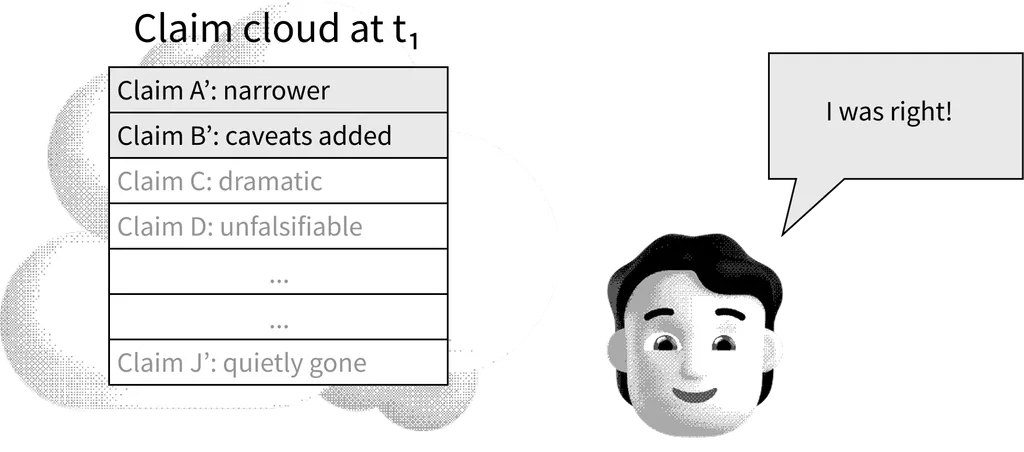 The original claim cloud evaporates and explodes at the same time.
The changed wording becomes the original wording.
The one correct claim launders a whole cloud of bullshit.
The cleanest example of this pattern is the anti-vaxxer victory lap.
Anti-vaxxers put out a whole cloud of garbage claims: microchips in the shot with Bill Gates tracking you, armchair-expert biology like wild mRNA theories.
Then the big claim that mRNA vaccines were the devil's way of controlling your biology narrowed down to one defensible fragment: the shots could cause heart inflammation in young men.
That turned out to have a real basis: rare, mostly young males, usually mild and self-resolving, risk generally lower than the myocarditis you'd get from COVID itself.
Of course, now the anti-vaxxers ride the victory lap.
They were right all along.
## II
Likely reasons the pattern exists:
- The obvious point: people don't only want to be right, they want to have been right all along.
- Consequence: correction of past claims feels like humiliation.
- There is status involved as well. If the claim-maker is a public thought leader with fans, the audience starts defending the thought leader, not just the claim.
- The argument gets hotter, because admitting you were wrong now means admitting it to yourself, to your opponent, and to the people who liked you for being right.
- The identity and status points extend to the fans as well.
- There's [research showing that we reconstruct our memories without noticing](http://www.self-definingmemories.com/bias_and_constructive_processes_in_a_self-memory_system.pdf): your current knowledge, beliefs, and feelings quietly reshape your memory of what you used to think and say.
- It's just easier to elaborate and convolute why you were right than to accept you were wrong.
- It's also why arguing rarely works: [persistent disagreement tends to run on self-favoring priors and self-deception](https://mason.gmu.edu/~rhanson/deceive.pdf), not a shared hunt for truth.
- Knowing something other people don't know is weirdly affirming for crackpots and conspiracy theorists alike.
## Related
- [The Exemption Outsourcing Pattern](/exemption-outsourcing)
- [All In All, Another Brick In The Motte](https://slatestarcodex.com/2014/11/03/all-in-all-another-brick-in-the-motte/)
- [Scott Alexander on Gary Marcus](https://www.astralcodexten.com/i/167709461/in-memoriam-your-last-set-of-goalposts-gone-but-not-forgotten)
- [Gwern on Gary Marcus](https://old.reddit.com/r/TheMotte/comments/v8yyv6/somewhat_contra_marcus_on_ai_scaling/ieixnwm/?context=2#thing_t1_ieixnwm)
- [roon on Gary Marcus](https://x.com/tszzl/status/2057680411317411883)
- [Gary Marcus on Gary Marcus](https://x.com/GaryMarcus)
The original claim cloud evaporates and explodes at the same time.
The changed wording becomes the original wording.
The one correct claim launders a whole cloud of bullshit.
The cleanest example of this pattern is the anti-vaxxer victory lap.
Anti-vaxxers put out a whole cloud of garbage claims: microchips in the shot with Bill Gates tracking you, armchair-expert biology like wild mRNA theories.
Then the big claim that mRNA vaccines were the devil's way of controlling your biology narrowed down to one defensible fragment: the shots could cause heart inflammation in young men.
That turned out to have a real basis: rare, mostly young males, usually mild and self-resolving, risk generally lower than the myocarditis you'd get from COVID itself.
Of course, now the anti-vaxxers ride the victory lap.
They were right all along.
## II
Likely reasons the pattern exists:
- The obvious point: people don't only want to be right, they want to have been right all along.
- Consequence: correction of past claims feels like humiliation.
- There is status involved as well. If the claim-maker is a public thought leader with fans, the audience starts defending the thought leader, not just the claim.
- The argument gets hotter, because admitting you were wrong now means admitting it to yourself, to your opponent, and to the people who liked you for being right.
- The identity and status points extend to the fans as well.
- There's [research showing that we reconstruct our memories without noticing](http://www.self-definingmemories.com/bias_and_constructive_processes_in_a_self-memory_system.pdf): your current knowledge, beliefs, and feelings quietly reshape your memory of what you used to think and say.
- It's just easier to elaborate and convolute why you were right than to accept you were wrong.
- It's also why arguing rarely works: [persistent disagreement tends to run on self-favoring priors and self-deception](https://mason.gmu.edu/~rhanson/deceive.pdf), not a shared hunt for truth.
- Knowing something other people don't know is weirdly affirming for crackpots and conspiracy theorists alike.
## Related
- [The Exemption Outsourcing Pattern](/exemption-outsourcing)
- [All In All, Another Brick In The Motte](https://slatestarcodex.com/2014/11/03/all-in-all-another-brick-in-the-motte/)
- [Scott Alexander on Gary Marcus](https://www.astralcodexten.com/i/167709461/in-memoriam-your-last-set-of-goalposts-gone-but-not-forgotten)
- [Gwern on Gary Marcus](https://old.reddit.com/r/TheMotte/comments/v8yyv6/somewhat_contra_marcus_on_ai_scaling/ieixnwm/?context=2#thing_t1_ieixnwm)
- [roon on Gary Marcus](https://x.com/tszzl/status/2057680411317411883)
- [Gary Marcus on Gary Marcus](https://x.com/GaryMarcus)